
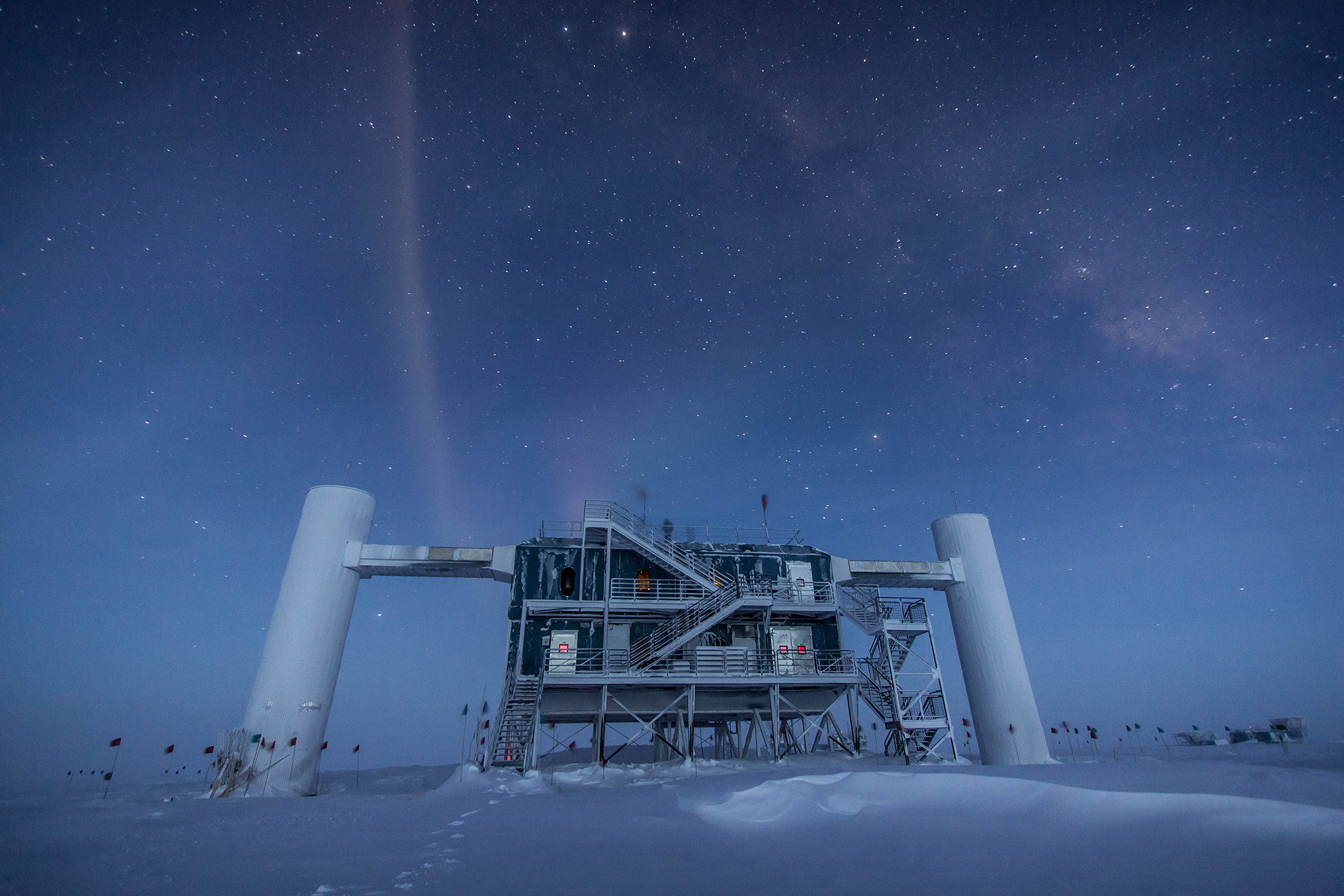
The recent revelation by the IceCube neutrino detector of particle showers associated with Glashow resonance has ignited a fervor within the scientific community. Embark with us on a journey into the intricate workings of the IceCube neutrino detector, delve into the enigma of Glashow resonance, and grasp the profound ramifications of this groundbreaking discovery. Our odyssey leads us through the pages of the prestigious journal Nature, Volume 591, Pages 220–224 (2021).
Exploring the Complexities of the IceCube Neutrino Observatory:
Nestled within the icy expanses of the South Pole, the IceCube Neutrino Observatory stands as a beacon of innovation. Crafted to capture the elusive high-energy neutrinos emanating from cosmic marvels like supernovae and black holes, this facility boasts a sophisticated array of Digital Optical Modules (DOMs). Within each DOM resides a photomultiplier tube and a data acquisition system, together weaving an intricate tapestry that unravels the mysteries of high-energy neutrinos in our universe.
The pinnacle of this endeavor reached fruition on a frigid December 18, 2010. Strings of DOMs, meticulously positioned at varying depths between 1,450 and 2,450 meters, were meticulously placed using specialized hot water drills. This meticulous arrangement ensures comprehensive neutrino detection, providing us with an astral portal into the cosmos.
Revealing Neutrino Interactions:
Neutrinos, often dubbed as "ghostly" particles, interact sparingly with matter. When they engage with water molecules within the ice, they give rise to charged particles, including electrons, muons, or taus. This cascade of secondary particles generates a unique phenomenon known as Cherenkov radiation, akin to the sonic boom of a supersonic aircraft. Ingeniously, IceCube's design allows us to capture this faint Cherenkov radiation, utilizing photomultiplier tubes within DOMs to illuminate the otherwise enigmatic behavior of neutrinos within the ice.
Embarking on a Cosmic Expedition:
A defining attribute of the IceCube Neutrino Observatory is its unparalleled ability to trace high-energy neutrinos across cosmic expanses. These daring messengers unveil narratives of cosmic upheavals such as supernovae and the mesmerizing, yet elusive, gamma-ray bursts. Through their revelations, we gain unparalleled insights into some of the universe's most extreme and enigmatic phenomena.
Unraveling the Glashow Resonance Enigma:
Central to this scientific saga lies the concept of Glashow resonance, a phenomenon paying tribute to Nobel laureate Sheldon Glashow. This resonance orchestrates the creation of a W boson through collisions between antineutrinos and electrons ($\bar{\nu}_e + e^- \rightarrow W^-$). The twist? This process requires an astonishing energy threshold of 6.3 PeV (Peta electronvolts), well beyond the capacities of conventional neutrino interactions on Earth. This colossal energy prerequisite confines Glashow resonance interactions to the cosmic theaters within celestial entities like supernovae and dazzling gamma-ray bursts.
IceCube's Monumental Attainment:
The triumph of IceCube lies in the detection of a neutrino boasting a staggering energy of approximately 6.3 PeV. This accomplishment confidently categorizes the neutrino as an astrophysical entity, substantiated at an impressive $5\sigma$ level of statistical significance. Importantly, data gleaned from the closest sensors to the interaction nexus, coupled with precise energy measurements, harmoniously align with theoretical predictions. This consonance validates the hadronic decay of a ${\rm W}^-$ boson through the mechanism of Glashow resonance.
Unveiling Cosmic Enigmas:
The repercussions of this discovery resound throughout the scientific cosmos. Neutrinos birthed via Glashow resonance afford us an unparalleled peek into the universe's most awe-inspiring processes. These very processes yield neutrinos with energies akin to those emanating from gamma-ray bursts—phenomena still cloaked in mystery. Gradually untangling the intricacies of these cosmic processes, scientists inch ever closer to deciphering the cryptic symphony underlying the universe's grand tapestry.
Nearing the Threshold of Cosmic Wisdom:
Amid the realm of gamma-ray bursts, the sourcing of neutrinos intertwines with the intricate choreography of multi-pion production during proton-gamma interactions, ultimately yielding antineutrinos. While this intricate dance may bewilder, the observation of Glashow resonance neutrinos within the hallowed halls of the IceCube Neutrino Observatory signifies a significant stride toward comprehending the nuanced mechanisms governing high-energy neutrino production.
Conclusion:
The IceCube Neutrino Observatory's triumph in detecting Glashow resonance neutrinos marks a pivotal juncture in cosmic exploration. Armed with ingenious design and strategic placement, IceCube transcends the conventional boundaries, ushering us into once-unattainable realms. As scientists meticulously sift through data, decode implications, and unveil cosmic narratives, a new frontier beckons—one where erstwhile theoretical concepts like Glashow resonance serve as bridges connecting Earth to the enigmatic core of the cosmos. Through these portals, profound insights await, potentially reshaping our comprehension of the fundamental symphony orchestrating the universe's majestic tapestry.
Comments
Post a Comment