
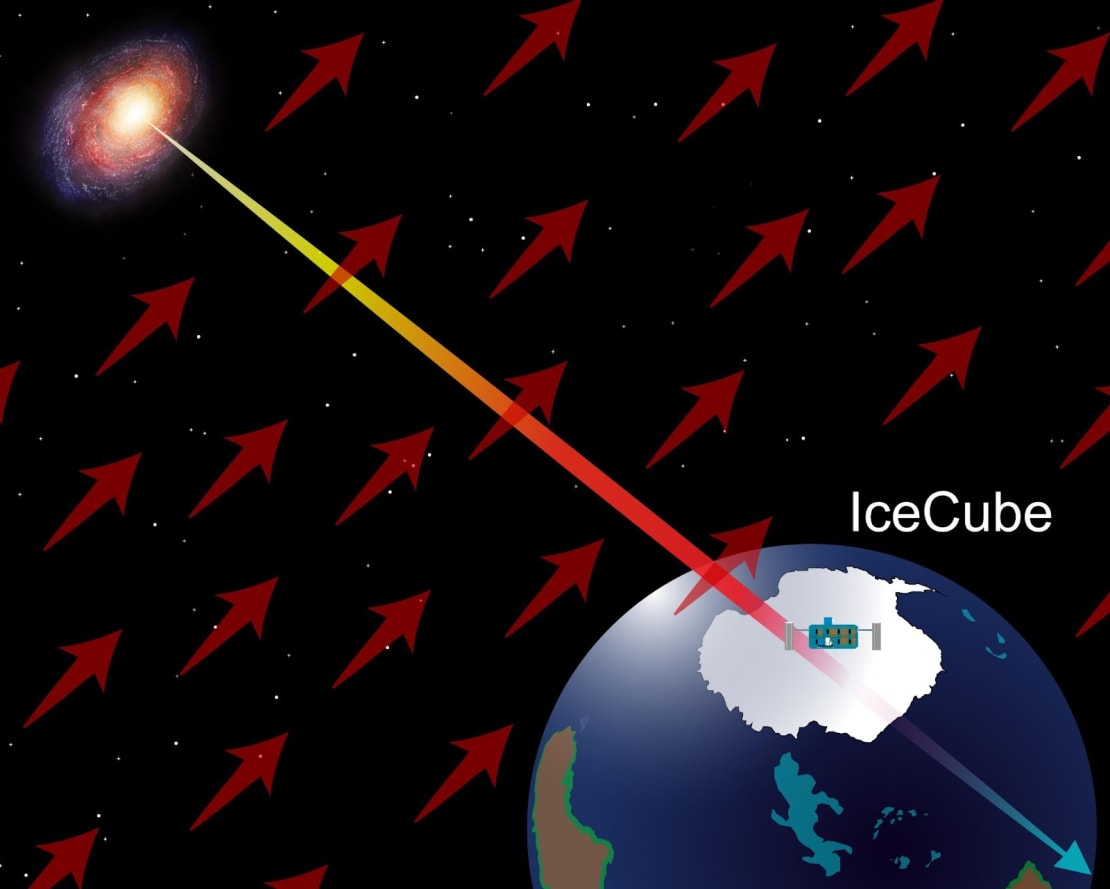
In the cosmic theater of particles and forces, a profound interplay between the micro and the macro unfolds, revealing the universe's intricate tapestry. Amidst this grand cosmic symphony, two enigmatic performers take center stage: neutrinos, the ethereal messengers that traverse space, and the elusive quantum gravity effects that beckon from the depths of the Planck energy scale. In an awe-inspiring display of scientific exploration, the IceCube Collaboration orchestrates a mesmerizing ballet between these realms, unraveling a narrative that resonates deeply within the annals of particle physics.
Neutrinos: Cosmic Wanderers and Flavor Metamorphosis
Neutrinos, the almost weightless cosmic travelers, have captured the imagination of scientists for decades. Born in the fiery cores of stars and cataclysmic celestial events, these ghostly particles possess a remarkable ability to metamorphose between three distinct "flavors" – the electron, the muon, and the tau – as they journey across the cosmos. This phenomenon, known as neutrino flavor oscillation, has not only expanded our understanding of fundamental particles but has also revealed fissures in the foundation of the Standard Model of particle physics, beckoning to be explored further.
Yet, the saga of neutrinos extends beyond their flavor transformations. The IceCube Collaboration, an international consortium of scientific minds, directs its gaze towards high-energy astrophysical neutrinos – particles that originate in the most energetic and remote corners of the universe. These neutrinos, resilient to the trials of their billion-year odyssey through the vacuum of space, serve as cosmic messengers carrying secrets from extreme realms of physics. Could they hold the key to unlocking the elusive domain of quantum gravity?
Quantum Gravity: Bridging Cosmic and Subatomic Realms
At the forefront of modern theoretical physics, the concept of quantum gravity beckons like a tantalizing mirage on the horizon. This theoretical framework seeks to weave together the microcosm governed by quantum mechanics with the gravitational tapestry that shapes the universe, as described by Einstein's general theory of relativity. Yet, this unification remains an elusive quarry, hidden behind the veil of the Planck energy scale – a realm that harkens back to the universe's primal moments, mere fractions of a second after the Big Bang.
The Planck energy scale, an ethereal energy regime beyond the grasp of current technology, offers a tantalizing proposition: could quantum gravity effects reverberate even within our observable, low-energy universe? Might these effects manifest themselves as subtle nuances in the behavior of particles such as neutrinos, imprinting a unique signature within their flavor oscillations? It is this enthralling riddle that the IceCube Collaboration embarked upon.
IceCube Neutrino Observatory:
Gateway to Discovery
Enter the IceCube Neutrino Observatory, an engineering marvel nestled deep within the heart of Antarctica. Comprising a cubic-kilometer array of detectors encased beneath layers of ice, this observatory stands as a sentinel to the cosmos, capturing the fleeting interactions of neutrinos that traverse astronomical distances. With exquisite precision, the observatory's detectors decipher the intricate signatures of neutrino flavor transformations, poised to unveil the universe's most intimate truths.
Chasing Whispers of Quantum Gravity
Empowered by this remarkable instrument, the IceCube Collaboration embarked on a daring quest that traverses the cosmic dance of neutrinos and probes the depths of quantum gravity. Their mission: to uncover any hint of anomalous flavor transformations that might allude to new, intricate spacetime structures or interactions, influenced by the delicate touch of quantum gravity.
In a crescendo that reverberates through the halls of science, the pursuit yielded its findings: no significant evidence of such anomalous transformations emerged from the astrophysical neutrino data. Far from a setback, this outcome underscores the monumental achievement of the endeavor. It underscores the unparalleled precision of IceCube's measurements, which have pushed the boundaries of existing technology to establish the most stringent limits conceivable.
A New Era in Quantum-Gravity-Inspired Physics
The implications of the IceCube Collaboration's study extend far beyond the absence of anomalies. Their discoveries illuminate an entirely new chapter in the exploration of quantum-gravity-inspired physics, firmly solidifying the parameter space within which these theories operate. This accomplishment marks a triumphant stride toward unraveling the dynamic interplay between neutrinos and the realm of quantum gravity – a realm once thought to have faded into the distant echoes of cosmic history.
In a universe that brims with enigmas, the IceCube Neutrino Observatory emerges as a beacon of illumination, unlocking insights that bridge both cosmic and quantum realms. With each neutrino that journeys through its detectors, a fresh page is turned in humanity's ongoing narrative to decipher the symphony of the cosmos. As the IceCube Collaboration's research kindles discussions, ignites debates, and inspires the flames of future inquiries, we are reminded that the pursuit of knowledge knows no bounds.
A Call to the Stars and Depths of the Quantum
As we reflect on the profound implications of the IceCube Collaboration's endeavors, we are beckoned to delve deeper into the mysteries woven into the universe's fabric. Neutrinos, those fleeting voyagers of the cosmos, and quantum gravity, the cosmic orchestrator of forces, stand as among the most captivating threads of existence. As our scientific instruments evolve in both sensitivity and sophistication, we stand poised on the threshold of discovery, ready to unveil the layers of secrets concealed within the cosmic and quantum realms.
Within the symphony of existence, the IceCube Neutrino Observatory's exploration stands as a poignant movement, harmonizing the rhythms of the cosmic and the quantum into a crescendo of comprehension. As our gaze turns towards the heavens, captivated by the allure of the stars, and dives deeper, entranced by the intricacies of the quantum, let our curiosity remain unquenchable, our diligence unwavering – for the universe's whispers await the attentive ears of explorers seeking to uncover its deepest truths.
Reference:
IceCube Collaboration. (2022). Search for quantum gravity using astrophysical neutrino flavour with IceCube. Nature Physics, 18, 1287–1292.
Comments
Post a Comment